
Master West Coast Swing Rotational Connection
West Coast Swing, Rotational Connection, Dance Techniques
West Coast Swing Rotational Connection: How to Turn Without Losing the Slot
Rotational connection in West Coast Swing can feel magical when it’s done well—smooth, elastic, and playful—yet it’s also one of the most confusing concepts for many dancers. Understanding how rotation works, how it differs from linear movement, and how to exit rotational moves back into a clean traveling slot is a game changer for your partner dancing.
Rotational Connection Is Not the Same as Linear
West Coast Swing is often described as a “slotted” dance, which leads many dancers to think only in straight lines: leaders at one end, followers traveling back and forth in a narrow lane. That’s only half the picture. Rotational Connection adds a circular dimension to those straight lines, but it does not replace them. It layers on top of the slot, rather than erasing it.
In a purely linear lead, energy is sent straight down the slot—think of a sugar push or a basic left side pass. The follower’s center moves mostly forward and back with minimal turning. In a rotational lead, the energy curves around the partnership. The connection creates a gentle arc so that bodies rotate around a shared axis, even if the feet are still stepping in the slot. This shift from straight to circular changes how you create and receive signals in your Swing Dance Basics.
📌 Key Takeaway: Linear connection moves your partner through space; rotational connection turns your partner around space. Both are essential Dance Techniques in West Coast Swing.
How Rotational Connection Feels in the Body
Rotational connection starts with tone and elasticity in the arms, back, and core. Instead of pushing or pulling straight forward and back, partners share a slight curve in the arm line—almost like holding a hula hoop between them. When the leader initiates a turn, they redirect the existing stretch into a spiral, not a yank or a spin from the arm alone. This is one of the most important Dance Connection Tips for keeping your partner safe and comfortable.
The leader rotates their body and frame, allowing the hand connection to guide the follower around a shared center.
The follower feels the curve in the connection and allows their body and feet to follow that arc, maintaining their own balance and timing.
Good rotational connection is smooth and progressive. You never want a sudden, sharp twist. The rotation builds from the feet and hips, then travels up the spine into the arms, so the whole body participates in the turn. This is what keeps West Coast Swing looking elastic and grounded, even when the shapes are big and expressive.
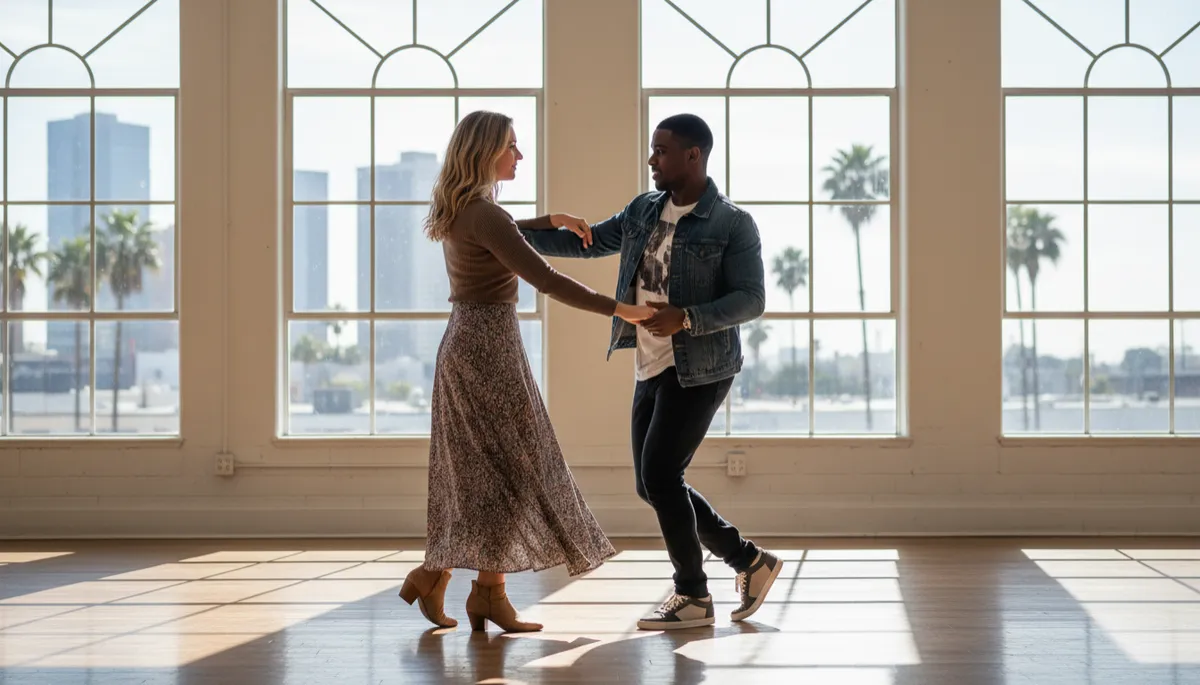
Clean rotation sets up effortless travel when leaders realign to the slot.
Exiting Rotational Moves into Linear Travel
One of the biggest challenges in West Coast Swing is exiting rotational moves into linear with travel while keeping the dance clear and musical. It’s easy to get stuck spinning in place or to accidentally cut across the slot. The secret is to think about where the rotation is sending your partner, not just how much they’re turning.
Finish the turn with a destination. As the rotation completes, the leader’s body should already be facing the intended direction of travel—usually down the slot. Your frame tells your partner, “We’re going this way next.”
Transform circular energy into linear stretch. At the end of the spiral, allow the connection to lengthen slightly along the slot. This smooth shift from curve to stretch signals the follower to move forward or backward instead of continuing to spin.
Use footwork to support the travel. Leaders, avoid planting your feet in the middle of the slot after a rotational pattern. Step slightly off-line or back out of the way so your follower has a clear lane to travel through.
For example, think of a tuck turn with extra rotation. As you finish the turn, the leader should unwind to face down the slot, absorb the end of the spin with soft knees, and then re-establish a gentle stretch away from the follower. That stretch is the bridge from rotational connection back into a classic linear pass or whip variation.
💡 Pro Tip: Count out loud when you practice. Make sure the rotation finishes by count 4 or 5 so you have time to set up travel on 5–6 or 6–7–8, depending on the pattern.
Practical Dance Connection Tips for Rotational Work
Keep your own balance. Don’t lean into your partner to “make” rotation happen. Each dancer stands over their own feet and uses core engagement to turn smoothly.
Let the frame, not the fingers, lead. Hands are just the connection point. The real lead comes from the torso rotating and traveling, which your partner can feel much more clearly.
Match energy to the music. Faster, punchier songs can handle sharper rotational accents, while slower or bluesy tracks invite softer, more elastic turns that melt back into linear movement.
Bringing It All Together on the Social Floor
When you blend linear and rotational connection thoughtfully, your West Coast Swing feels dynamic without becoming chaotic. The slot gives your dance clarity and structure; rotation adds texture, play, and personality. Remember that rotational connection is not the same as linear—it’s a complement to it. Your goal is to rotate with purpose and then exit with direction, using clean travel to reset the partnership.
Whether you’re new to Swing Dance Basics or polishing your competition routines, spending focused time on rotational connection will sharpen your overall Dance Techniques and make your partner dancing more enjoyable for both sides. Practice slowly, stay curious about how the connection feels, and let each turn naturally flow back into the slot. That’s where West Coast Swing truly comes alive.
